
Earthquake and Catastrophe Data Sources
Catastrophe parametric cover depends on fast, independent measurement of major events, which makes catastrophe data sources central to how it works.
Earthquakes, hurricanes and floods are all monitored by public agencies and market indices that publish objective readings within hours.
This guide covers the main catastrophe data sources behind catastrophe parametric cover, from seismic networks to industry loss indices, explains how each type of event is measured, and shows why independent monitoring is essential to a trustworthy trigger.
Earthquake data
Seismic networks publish the magnitude, location and depth of earthquakes almost in real time. For a parametric earthquake policy, a trigger can be set on magnitude at a defined distance from the insured site, giving a fast and objective basis for the payout. Because seismic readings are produced within minutes and published by neutral monitoring agencies, earthquake is one of the cleanest perils to structure parametrically. The data is unambiguous, widely available and difficult for either party to influence.
Hurricane and windstorm data
Meteorological agencies track wind speed, central pressure and storm tracks for hurricanes and windstorms. A parametric policy can use a physical trigger, such as maximum sustained wind speed within a defined radius of a site, or an industry loss index for a broader portfolio. Best track data, published after a storm, provides the authoritative record of the storm's intensity and path. These sources make it possible to pay on the storm itself rather than waiting for damage to be assessed. See hurricane cover.
Flood and other perils
Flood is measured through river gauges, rainfall accumulation and satellite mapped extent, each providing an independent view of the event. Other catastrophe perils, such as wildfire and volcano, have their own recognised monitoring, from satellite fire detection to volcano observatories. In every case the principle is the same: an independent, published measure of the event stands in for an assessment of the loss, allowing the policy to pay quickly. See flood cover and satellite data.
Industry loss indices
For catastrophe risk written on an industry loss warranty basis, the trigger is an industry loss index, a market wide estimate of insured losses from an event. Industry loss triggers suit capital partners and reinsurance buyers who want exposure to a class of catastrophe risk rather than a single insured asset. They are transparent and widely used, and they allow large, liquid parametric structures to be built around recognised market data.
Why independent monitoring matters
What all these catastrophe data sources share is independence. They are neutral, published and hard to influence, which is exactly what a trustworthy trigger needs. If the data behind a catastrophe payout could be shaped by either party, the whole basis of parametric cover would collapse. Independent monitoring is therefore not a technical detail but the foundation of confidence for buyers, insurers and capital partners alike. See why independent data matters.
How catastrophe data is published
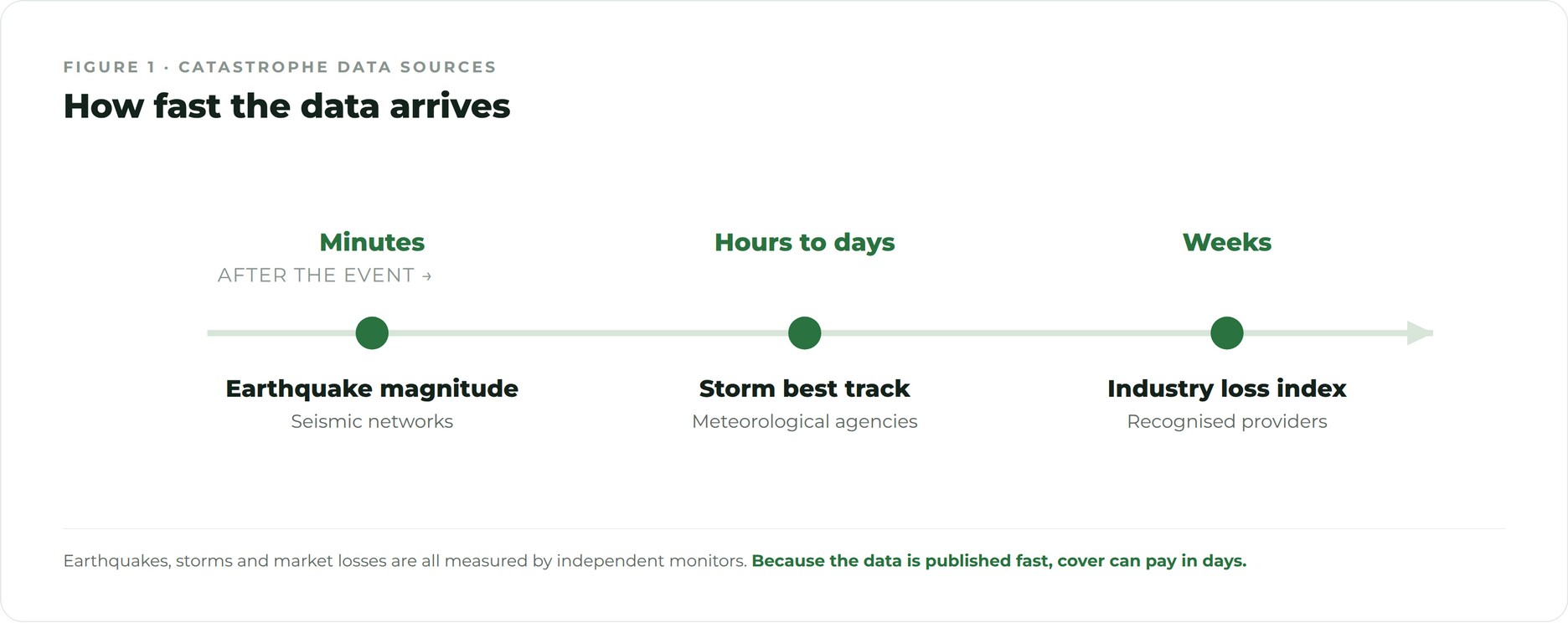
A feature of catastrophe data is how quickly it becomes available. Seismic networks issue magnitude and location estimates within minutes of an earthquake, and refine them over the following hours. Meteorological agencies track storms continuously and issue authoritative best track data after the event. Industry loss estimates are published by recognised providers in the weeks after a major catastrophe. This rhythm of publication shapes how fast a parametric catastrophe policy can pay, which is why the choice of source and the definition of the trigger are set with the publication schedule in mind.
Modelled versus reported data
Catastrophe triggers can rely on directly reported measurements, such as a recorded wind speed or magnitude, or on modelled outputs that estimate an event's characteristics from a network of observations. Reported data is simple and transparent, while modelled data can fill gaps where direct measurements are sparse, for example estimating ground shaking between seismic stations. Each has its place, and the choice affects both the speed and the basis risk of the cover. A well designed catastrophe trigger is explicit about which it uses and why.
Sources: USGS Earthquake Hazards