
Why Independent Data Matters
Independent data is what makes parametric insurance trustworthy.
Because a parametric policy pays on a measurement, both sides have to trust that measurement completely. If the data came from the party being paid, the trigger would be open to question and the confidence that makes parametric work would collapse.
Understanding why independent data matters is central to understanding why parametric cover is credible. This guide explains the trust problem independent data solves, why counterparty data is avoided, what independent really means, and how every source is graded before it is used.
The trust problem parametric insurance solves
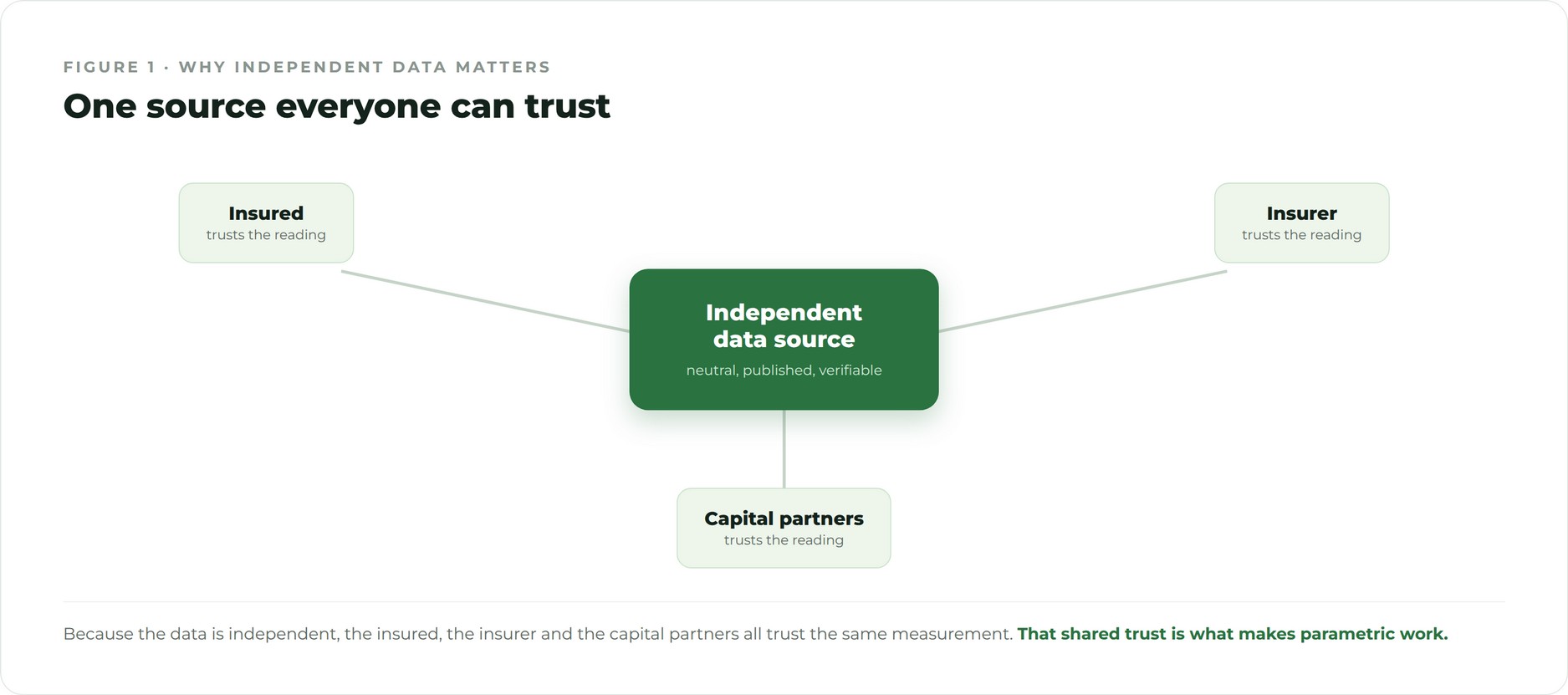
A parametric payout should be beyond argument. That only holds if the data behind it is neutral, published and verifiable by everyone involved, from the insured to the capital partners standing behind the risk. In a traditional claim, trust is established after the event by an adjuster who investigates the loss. In a parametric policy, trust is established before the event by choosing a data source that no one can dispute. Independent data is what makes that possible, and it is the reason a parametric payout can be made so quickly and with so little friction, a point explored further in why parametric insurance.
Why counterparty data is avoided
A parametric structure should never rely on data provided by the party being paid, because that would create an incentive to influence the reading. Instead, cover uses independent third party data only. This protects the integrity of the trigger and, just as importantly, the confidence of the capital partners and reinsurance markets that support the risk. They will only deploy capacity behind a trigger they can trust, and a trigger built on counterparty data fails that test immediately.
What independent really means
Independent data means a source that is external to both parties, published, methodologically transparent and outside the control of either side. National meteorological agencies, seismic monitoring networks, earth observation programmes and recognised index providers all meet this standard. The key features are that the data is produced for a purpose beyond any single insurance contract, that its method is documented, and that it is available to everyone. These qualities are what make the measurement authoritative.
How data sources are graded
- Public or private. Is the reporting agency public, and is its methodology published?
- Record length. How long and complete is the historical series?
- Collection method. Is the data collected automatically or by survey, and is it pre processed?
- Durability. What is the risk of the source being discontinued during the policy?
Independent data and credibility
Independent data is ultimately about credibility. It is what lets a buyer trust that they will be paid, an insurer trust that the trigger is sound, and a capital partner trust that the risk is what it appears to be. A parametric risk partner that uses independent data only, and grades every source before use, is signalling that its structures can be relied on. In parametric insurance, credibility comes from process and data, not from presentation, and independent data is the heart of that process.
Independent data and capital partners
The importance of independent data is felt most strongly by the capital partners who stand behind parametric risk. Reinsurers and investors will only deploy capacity behind a trigger whose data they can trust completely, because they cannot inspect each loss the way a traditional claims process would. Independent, published data gives them that trust. It means the risk they are taking on is exactly what the contract describes, measured by a neutral source, with no room for either party to influence the outcome. Independent data is therefore not only about fairness to the buyer, but about the willingness of the market to provide cover at all.
What happens if a data source fails
A well designed structure also plans for the possibility that a data source changes or stops. Because a trigger depends on its source being published throughout the policy, structurers assess the risk of discontinuation before selecting a source, and may specify a fallback or an alternative provider. This forward planning protects the buyer from being left with a trigger that can no longer be measured. It is another reason durability, not just accuracy, is one of the tests every source must pass.