
How Trigger Calibration Works
Trigger calibration is how a parametric trigger is tuned to match your real exposure.
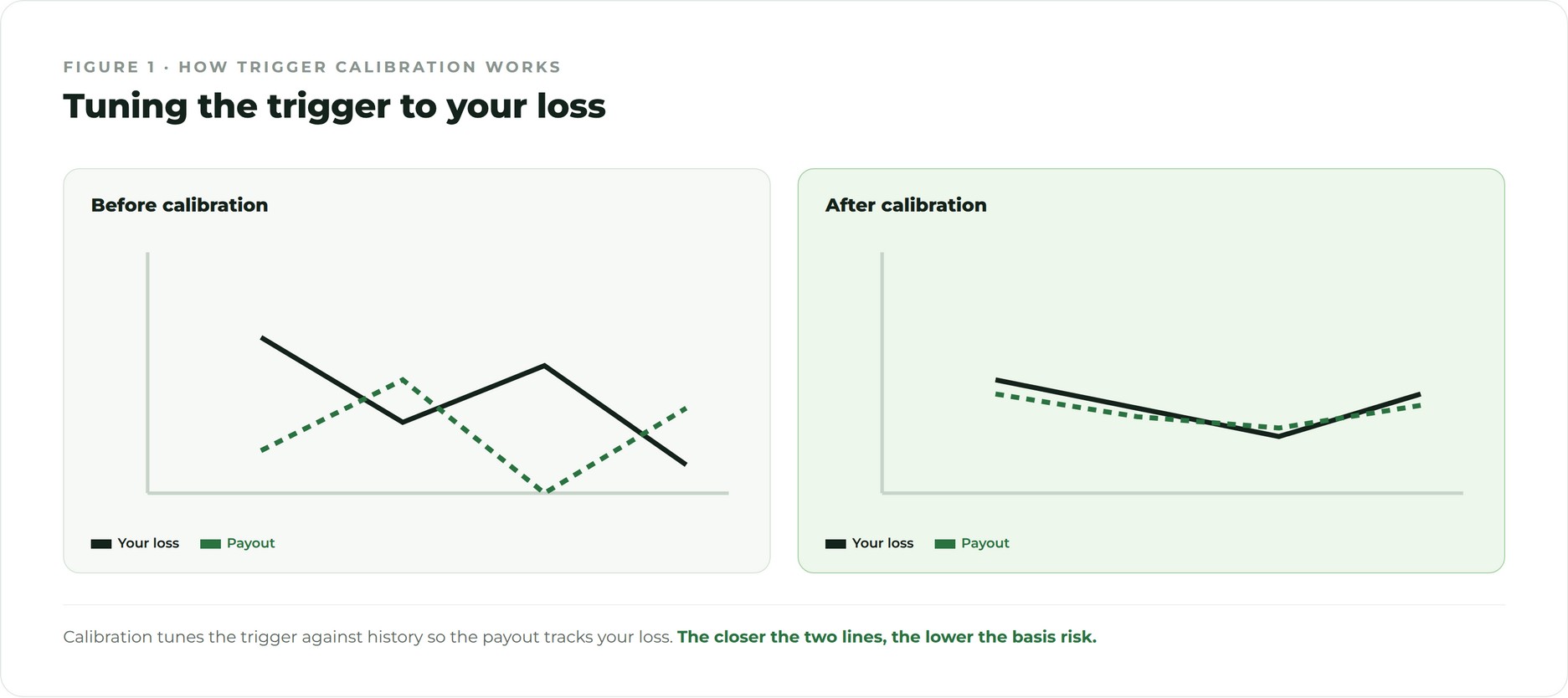
It is the step that decides whether a payout closely tracks your loss or drifts away from it. By testing a proposed trigger against history and adjusting the threshold and payout scale, calibration keeps basis risk low and the cover behaving as intended.
Understanding how trigger calibration works shows why two triggers on the same peril can perform very differently. This guide explains what calibration is, how it aligns the trigger to your exposure, the role of the payout scale, and how accuracy is balanced against cost.
What calibration is
Calibration sets the exact threshold and payout scale for a trigger, using historical data, so the cover fires at the point your business actually feels the impact rather than too early or too late. A trigger without careful calibration is a blunt instrument: it might pay when you are barely affected, or fail to pay when you are badly hurt. Calibration is what turns a rough idea of a trigger into a precise contract that behaves the way you need. It is one of the clearest ways a skilled structurer adds value.
Aligning the trigger to real exposure
The trigger is tested against past events and, where possible, against your own loss history, then adjusted so payouts line up with real outcomes. If the analysis shows the trigger would have paid in years you were fine, or stayed silent in years you suffered, the threshold or index is refined until the fit improves. This is especially important for weather parametric insurance covering perils such as drought, where seasonal variability is high. This alignment is the direct route to reducing basis risk, because a well calibrated trigger pays close to what you need across a long run of history.
The role of the payout scale
Calibration also shapes the attachment, exhaustion and maximum payout points, so the cover ramps up in line with the severity of the event. Setting the attachment point too high leaves a gap for smaller but still damaging events. Setting the exhaustion point too low caps the cover before your worst losses are met. Calibrating these points, so the payout profile matches the way losses grow with severity, is as important as setting the trigger threshold itself.
Balancing accuracy and cost
Tighter calibration reduces basis risk but can raise the price, because it transfers more of the real risk to the insurer. Good structuring finds the balance that gives you meaningful protection at a fair cost. That balance depends on how much residual risk you are willing to carry and how critical a close match between payout and loss is for your business. The goal of calibration is not the tightest possible trigger, but the one that best fits your needs and budget.
Calibration and confidence
A well calibrated trigger is one you can trust to perform. Because it has been tested against history and tuned to your exposure, you can see, before you buy, how it would have behaved in past events. That evidence is what gives a buyer confidence, and what allows a parametric risk partner to stand behind the structure. Calibration, together with independent data and sound modelling, is what makes the promise of parametric insurance credible.
How calibration is tested
Calibration is not a matter of judgement alone, it is tested against evidence. The proposed trigger and payout are run across the historical record to see how they would have performed in past events, and, where available, compared against the buyer's own loss history. This back testing reveals whether the cover would have paid too much, too little or about right, and it guides the adjustments that follow. A calibration that survives this testing across many years is far more trustworthy than one set on theory, because it has been shown to work on real events.
Recalibrating over time
Exposure and data can change, so calibration is not always a one time exercise. As a business grows, moves or changes its operations, and as longer data records become available, a trigger may be recalibrated at renewal to keep the fit close. Recognising that calibration can evolve is part of maintaining a parametric programme well, and it ensures the cover continues to track the real exposure rather than drifting away from it as circumstances change.