
What Makes a Good Parametric Trigger?
A good parametric trigger is one that pays when you are actually hurt, using data everyone can trust.
Because the trigger governs when a parametric policy pays and how closely the payout matches your loss, the quality of the trigger largely determines the quality of the cover.
A weak trigger creates basis risk and disappointment; a strong one delivers on the promise of parametric insurance. This guide sets out the qualities of a good parametric trigger, the data it needs, how design and calibration keep it accurate, and the balance between precision and cost.
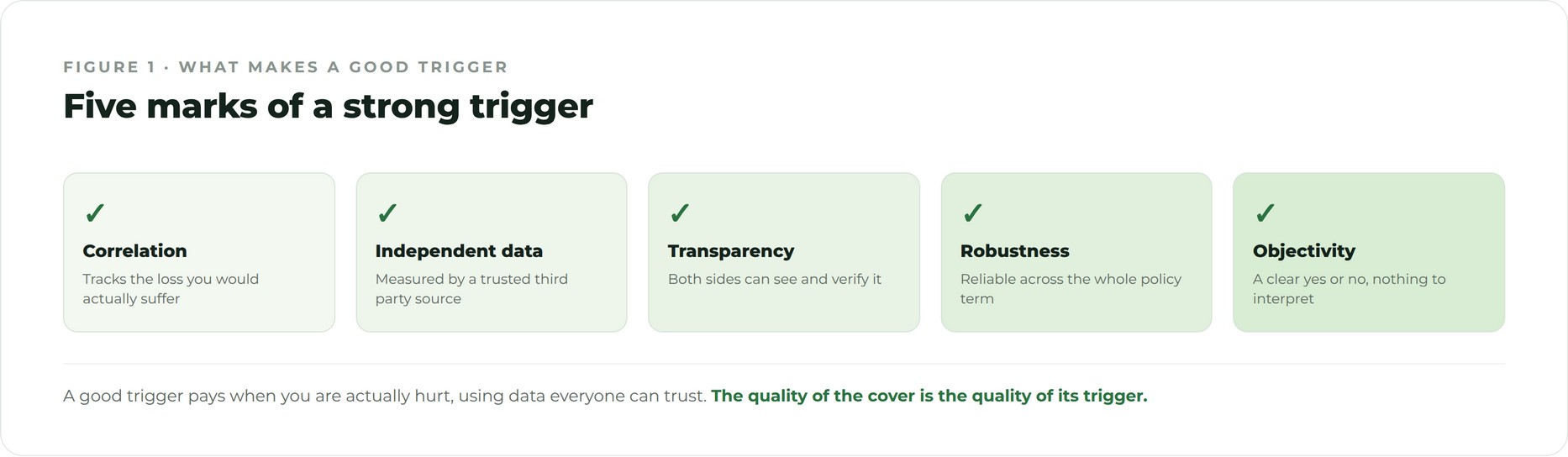
The qualities of a strong trigger
- Correlation. It closely tracks the loss you would actually suffer, so payouts and losses move together.
- Independent data. It is measured by a trusted third party source, never by the insured.
- Transparency. Both sides can see and verify the measurement, so the outcome is never in doubt.
- Robustness. The data is reliable and available over the whole policy term.
- Objectivity. The result is a clear yes or no, with nothing left to interpret.
Correlation: the most important quality
Of all the qualities, correlation matters most, because it determines basis risk. A trigger that tracks your loss closely will pay roughly what you need when an event hits. A trigger that tracks it loosely will sometimes overpay and sometimes underpay. Correlation is improved by choosing an index that genuinely drives your exposure, measuring it at or near your site, and defining the window to match the period in which you are affected. Testing the proposed trigger against a long run of history is the clearest way to confirm the correlation is strong, whether the peril is hurricane wind speed or a drought rainfall index.
The data a good trigger needs
A trigger is only as good as the data behind it. That means a long and complete historical record, a transparent and consistent measurement method, and a source that will keep publishing throughout the policy. Independent, published data from national agencies, satellites and recognised index providers is the foundation. Before any source is used it is graded on these points, because a trigger built on weak data will disappoint no matter how well the rest of the structure is designed. See what data is used and why independent data matters.
Designing to reduce basis risk
Good design and careful calibration keep the gap between trigger and loss small. That involves choosing the right index and location, setting the threshold against your own history, structuring the payout in steps rather than a single cliff edge, and using more than one condition where it tightens the link. Basis risk is assessed at the structuring stage for every deal, so the finished trigger behaves the way the buyer expects. A good parametric risk partner will show you the basis risk before you commit, not after.
Balancing accuracy and cost
A tighter trigger reduces basis risk but can cost more, because it transfers more of the real risk. The art of structuring is finding the point that gives you meaningful, dependable protection at a fair price. That balance depends on how much residual risk you are willing to carry and how critical a close match between payout and loss is for your business. A well designed trigger is not simply the tightest possible one, but the one that best fits your needs and budget.
Signs of a weak trigger
It is as useful to recognise a weak trigger as a strong one. Warning signs include data drawn from a source with a short or patchy history, a measurement point far from the real exposure, a window that does not match when the business is affected, or a threshold set without testing against past events. A trigger that has not been back tested against history is a particular concern, because there is no evidence of how it would actually have performed. Spotting these signs early prevents disappointment later, when the policy is called upon.
The role of the structurer
A good trigger rarely happens by accident. It is the product of careful work by an experienced structurer who understands both the peril and the buyer exposure. That work involves selecting the right data, testing the trigger against history, calibrating the threshold and payout, and being honest about the residual basis risk. The value a parametric risk partner adds is largely in this design work, because the same peril can be covered by a strong trigger or a weak one, and only the strong one delivers on the promise of parametric insurance.