
What is an Insurance Trigger?
In parametric insurance, the insurance trigger is the measurable condition that makes the policy pay.
It is agreed before cover starts and defined precisely: a wind speed, a rainfall total, an earthquake magnitude or an industry loss index reaching a set level. When the trigger is met, the payout follows.
Understanding the insurance trigger is central to understanding parametric cover, because the trigger determines when you are paid, how much, and how closely the payout matches your loss. This guide explains what a parametric trigger is, the main types, how the threshold is chosen, and what separates a strong trigger from a weak one.
What a trigger is, and why it matters
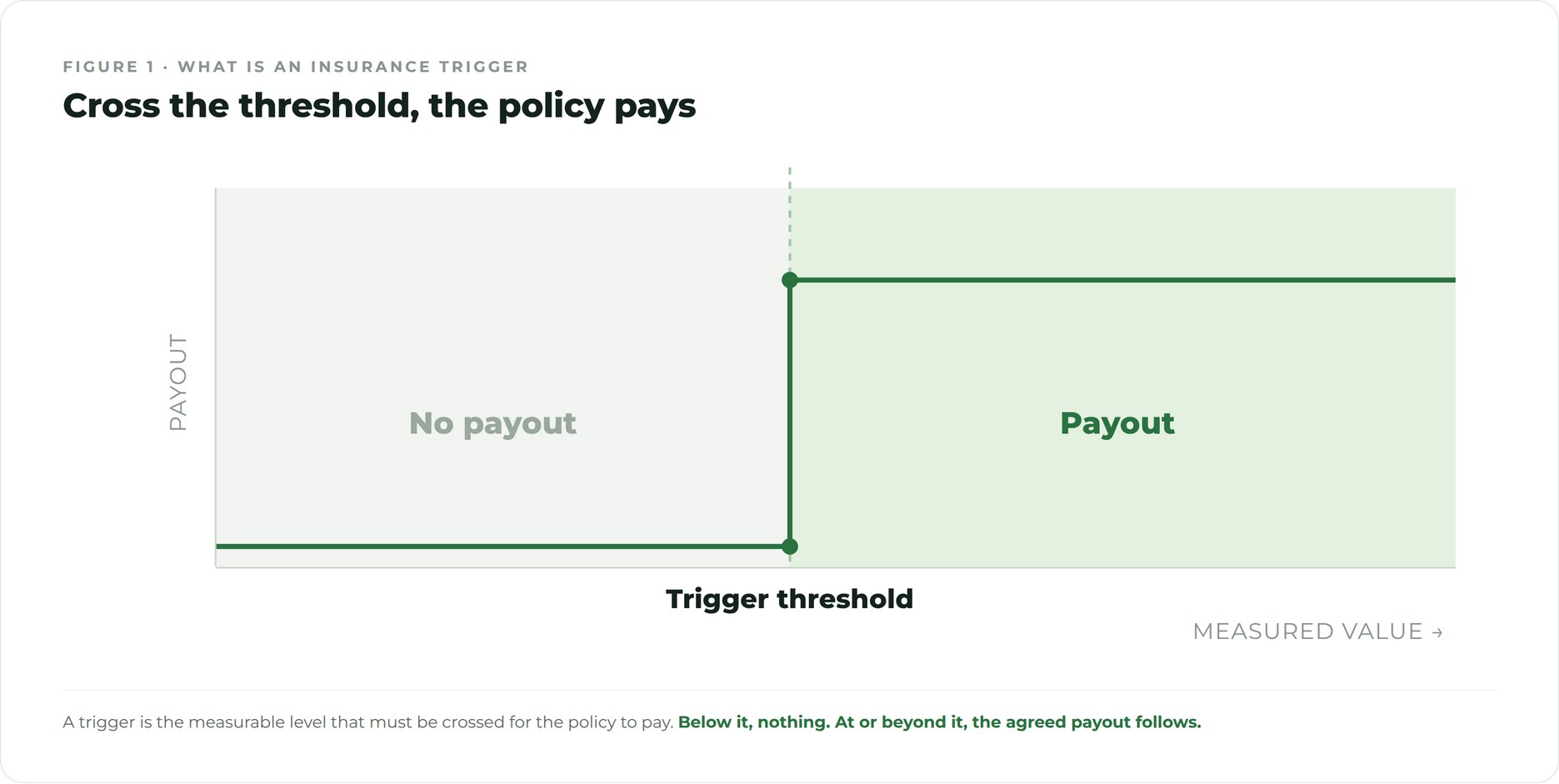
A trigger turns a real world event into a yes or no test. Either the measured value crossed the agreed threshold or it did not. That clarity is what lets a parametric policy pay quickly and without dispute, because there is nothing subjective to argue about. The trigger also defines the boundary of the cover: it decides which events pay and which do not, so getting it right is the single most important part of designing a parametric policy.
The main types of parametric trigger
Index triggers
An index trigger is based on a published measure, such as a rainfall total, a temperature average or an industry loss index. Index triggers are efficient and easy to verify, and they suit risks that affect a whole area or market rather than a single asset. See index based insurance explained.
Physical parameter triggers
A physical parameter trigger uses a direct reading of the event itself, such as earthquake magnitude at a defined distance, wind speed at a location, or river level at a gauge. These triggers tie the payout closely to the physical event a business experiences.
Industry loss triggers
An industry loss trigger is based on a market wide loss figure, used in industry loss warranty structures. It suits capital partners and reinsurance buyers who want exposure to a class of risk rather than a single insured.
How the threshold is set
The threshold is the level the trigger must reach to pay. It is calibrated to your exposure using historical data, so the policy fires when you actually feel the impact. Set the threshold too high and you can suffer a loss without a payout. Set it too low and you pay for cover you do not need. This balance is where trigger calibration and basis risk assessment matter most, and where an experienced structurer earns their keep. The aim is a threshold that closely matches the point at which the event begins to hurt your business.
Single and dual triggers
Some structures use more than one condition. A dual trigger might require an event of a given size within a given distance, or a combination of two measures, before it pays. Dual triggers can tighten the link between the payout and your actual loss, reducing basis risk, at the cost of some added complexity. The right choice depends on how precisely the risk needs to be tracked and how the data behaves.
Trigger and payout: two separate decisions
It is worth separating two things that are easy to confuse. The trigger decides whether the policy pays. The payout scale decides how much. A binary structure pays a fixed amount once the trigger is met, while a scaled structure pays more as the event grows more severe, up to a maximum. Both the trigger and the payout are written into the contract before cover begins, so the behaviour of the policy is fully known in advance.
What makes a trigger reliable
A reliable insurance trigger uses independent, published data from a source that will keep reporting throughout the policy, tracks your exposure closely, and is clear enough that the outcome is never in doubt. Weak triggers, by contrast, rely on thin data, sit too far from the real exposure, or leave room for interpretation. Because the trigger governs everything, the quality of a parametric policy is really the quality of its trigger. Learn more in what makes a good parametric trigger.
Why the trigger defines the cover
Because the trigger decides exactly which events pay, it also defines the edges of the cover. Two policies on the same peril can behave very differently depending on where their triggers sit. This is why the trigger is agreed with such care, and why it is worth understanding in detail before buying. A trigger is not a technicality buried in the wording, it is the product itself, and the quality of the cover is really the quality of its trigger.