
How Does Parametric Insurance Work?
How does parametric insurance work?
Parametric insurance works by agreeing, in advance, exactly what event will trigger a payout and exactly how much that payout will be. When independent data confirms the event has happened, the money is paid. There is no claim to file in the traditional sense and no loss to adjust.
This guide walks through the four steps of the parametric insurance process, explains how the trigger and payout are structured, sets out the role independent data plays, and shows why settlement is so much faster than conventional cover.
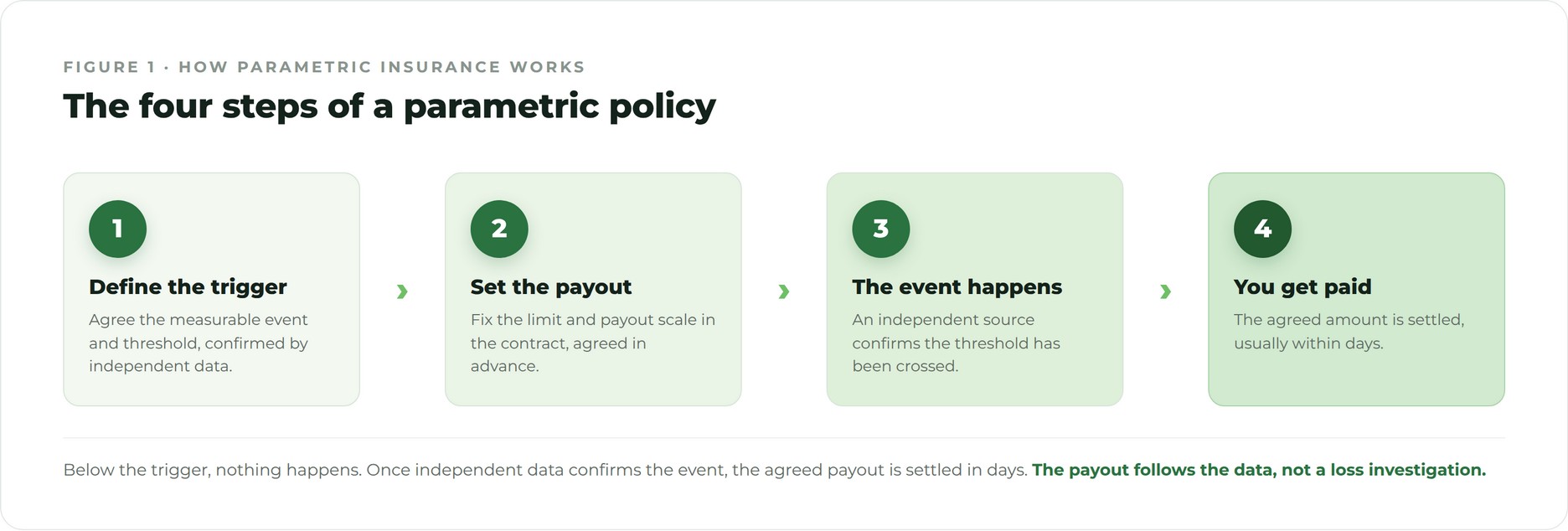
The four steps of parametric insurance
- Define the trigger. Agree the event and the threshold, for example rainfall below a level or a quake above a magnitude, measured by an independent source.
- Set the payout. Choose the limit and the payout scale, written into the contract before cover starts.
- The event happens. An independent source confirms the threshold was crossed.
- You get paid. The agreed amount is settled, typically within days.
Step one: defining the trigger
The trigger is the heart of a parametric policy. It has to be measurable, independent and closely linked to your actual exposure. Choosing the right index, the right location and the right threshold is what keeps basis risk low and makes the cover behave the way you expect. A trigger can be a physical parameter, such as wind speed or earthquake magnitude at a defined point, or an index, such as an industry loss figure or a rainfall total over a season. The clearer and more objective the trigger, the faster and cleaner the eventual payout. See what is an insurance trigger.
Step two: structuring the payout
Once the trigger is set, the payout is structured. Parametric payouts come in two broad shapes. A binary payout pays a fixed amount the moment the trigger is met. A scaled payout rises with the severity of the event, between an attachment point where cover begins and an exhaustion point where the maximum is reached. Scaled structures track your loss more closely, which reduces basis risk, while binary structures are simple and easy to price. In both cases the terms are fixed in the contract before cover starts, so you know exactly what you will receive.
Step three: the role of independent data
Everything in parametric insurance hinges on a trusted, independent measurement. The data must be published by a credible source, outside the control of either party, so that neither side can influence the outcome. Sources include national meteorological services, seismic networks, earth observation satellites and recognised industry loss and market indices. Before any source is used, it is graded on its history, its method and the risk of it being discontinued. This discipline is what gives a parametric payout its authority. See what data is used in parametric insurance.
Step four: how and when you get paid
When the event occurs, the independent data is checked against the agreed trigger and payout scale. If the trigger is met, the amount is confirmed and settled, usually within days. There is no loss adjusting, no proof of loss and no negotiation, because the payout follows the data, not an assessment of your damage. Most of the elapsed time is simply the wait for the official data to be published, not a wait for a decision. See how parametric claims are paid.
A worked example
Consider a farm exposed to drought. The trigger is set at a rainfall level for its region across the growing season, using an independent rainfall index. If measured rainfall falls below that level, the agreed sum is paid, with no need to prove crop loss. A factory exposed to earthquakes might instead use a magnitude trigger at a set distance, and a hotel exposed to hurricanes a wind speed trigger within a defined radius. The mechanism is the same in each case: an agreed, measured event produces an agreed payout.
Why parametric insurance pays so quickly
Because there is no loss to assess, payment usually follows within days of the data confirming the trigger. That speed is the whole point of parametric insurance. Cash in the first week after an event funds the decisions that shape recovery, while a conventional claim would still be open. Understanding how parametric insurance works, and building the trigger and data around settlement speed, is what turns that promise into reality.
Who is involved in a parametric policy
Several parties sit behind a parametric policy. The insured agrees the trigger and pays the premium. The parametric risk partner designs and prices the structure and arranges the cover. Independent data providers supply the measurements that confirm the trigger. And capacity providers, typically rated reinsurance markets, stand behind the risk. Because the payout follows neutral data, each party can rely on the same evidence, which is what allows the process to move so quickly when an event happens. See capital partners.