
What is Parametric Insurance?
What is parametric insurance?
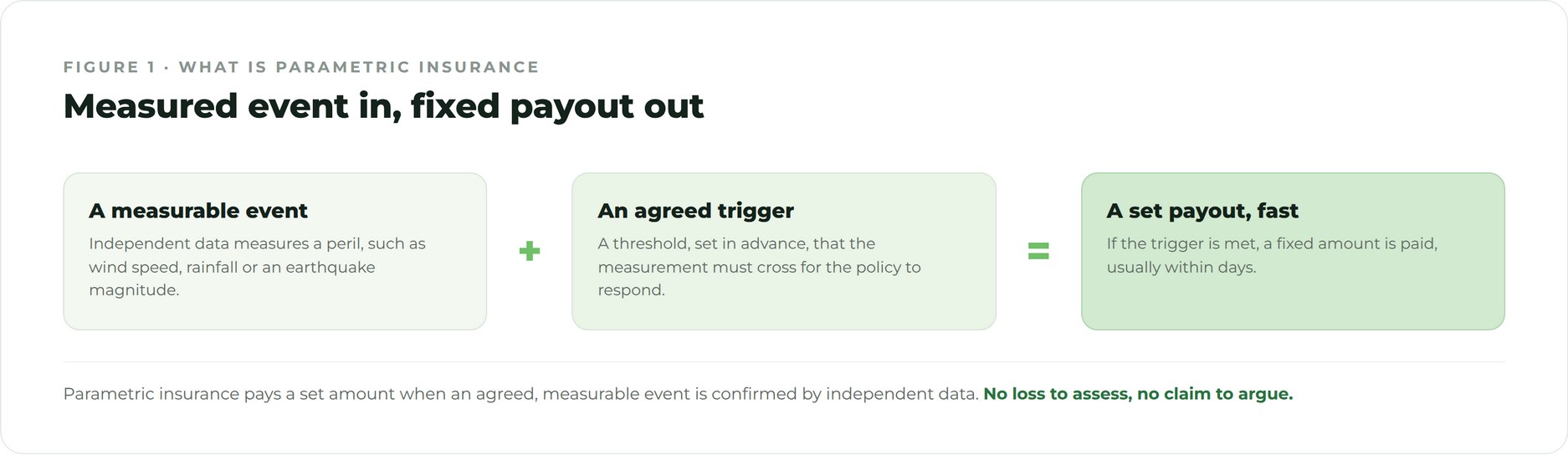
Parametric insurance is a type of cover that pays a fixed, agreed amount when a measurable event crosses a pre agreed threshold, rather than reimbursing an assessed loss. Instead of a claim, a loss adjuster and a negotiation, a parametric policy relies on independent data. If the trigger is met, the payout is made, usually within days.
That makes parametric insurance fast, transparent and well suited to risks that traditional insurance handles poorly, such as weather, catastrophe and commodity exposure. This guide gives a complete parametric insurance definition, explains how it works in practice, sets out its benefits and trade offs, and shows where it fits for businesses that need certainty when an event strikes.
The parametric insurance definition
At its simplest, parametric insurance pays on a parameter, a measurable value, rather than on a loss. A conventional policy indemnifies you for damage once it has been assessed. A parametric policy instead pays a set amount when an agreed event is confirmed by an independent source, whatever your actual damage turns out to be. The word parametric comes from that reliance on a measured parameter, such as wind speed, rainfall, an earthquake magnitude or an industry loss index. Because the payout is tied to data rather than to an adjusted claim, it can be calculated and settled quickly and objectively.
How parametric insurance works
A parametric policy has two agreed parts: a trigger and a payout. The trigger is the measurable condition that must be met, for example rainfall below a level or a quake above a magnitude. The payout is the amount you receive when it is. Both are written into the contract before cover begins. When an independent data source confirms the trigger has been met, the agreed amount is paid, with nothing to prove and nothing to adjust.
The result is a policy that behaves like a switch. Below the trigger there is no payout. At and beyond the trigger the payout is made, often scaling with the severity of the event up to an agreed maximum. This clarity is what allows parametric insurance to settle in days rather than the weeks or months a traditional claim can take. You can read the full mechanism in how does parametric insurance work.
How parametric insurance differs from traditional cover
Traditional indemnity insurance reimburses a loss after it has been measured and verified, which takes time and can lead to disputes and exclusions. Parametric insurance pays the agreed amount the moment the trigger is confirmed. One approach measures your damage, the other measures the event. That single difference gives parametric its speed, its transparency and its ability to cover risks the standard market restricts. The trade off, covered below, is basis risk. See the full comparison in parametric vs traditional insurance.
What parametric insurance covers
Parametric structures work for almost any risk that can be tied to reliable, independent data. In practice that spans catastrophe perils such as earthquake, hurricane and flood, weather perils such as drought, heat and frost, specialty risks such as wildfire and business interruption, and commodity price and volume exposure. It is used by corporates protecting revenue, lenders protecting loan books, governments funding disaster response, and reinsurance markets seeking diversifying, data driven risk.
The benefits of parametric insurance
- Speed: settlement in days rather than months, because there is no loss adjusting
- Certainty: the payout is defined in the contract upfront, so there is little to dispute
- Flexibility: the money is yours to use wherever recovery needs it, not tied to one repair
- Reach: cover for perils and regions the standard market restricts or declines
- Transparency: the data decides, so the outcome is objective and easy to verify
The main trade off: basis risk
The one real trade off in parametric insurance is basis risk, the chance that the payout does not exactly match your loss. Because the policy pays on a measured event rather than your specific damage, a gap can open between the two. Good trigger design and careful calibration keep that gap small, and an honest structurer will tell you where it sits before you buy. Understood and managed, basis risk is a reasonable price for the speed and certainty parametric provides. Understand it in what is basis risk.
Is parametric insurance right for you?
Parametric insurance is strongest where a risk is measurable and where speed of payment would change the outcome. It is not a fit for every loss, and it usually works best alongside traditional cover rather than replacing it, filling the gaps that indemnity policies leave. If your business carries weather, catastrophe or commodity exposure that the standard market handles slowly or not at all, parametric insurance is worth exploring. The best starting point is to identify the exposures that are both measurable and time sensitive, then test a structure against your own history before you commit. See when to use parametric insurance.
A short history of parametric insurance
Parametric insurance is not new in principle. Cover linked to a measurable index has existed for decades, first in agriculture and in catastrophe risk transfer between reinsurers. What has changed is the data. The growth of satellite observation, dense weather networks and recognised market indices has made far more risks measurable, and made the triggers behind them more accurate. As a result, parametric insurance has moved from a specialist tool used mainly by governments and reinsurers into a practical option for ordinary businesses. Today it is one of the fastest growing parts of the insurance market, precisely because the data now exists to structure cover for risks that were previously impossible to measure.
How to buy parametric insurance
Buying parametric insurance starts with identifying a measurable, time sensitive exposure, then sharing the basics of the risk: the peril, the location, the period and any data you hold. From there a structure is designed around an independent data source, tested against history, and priced. Because the cover is bespoke, the process is a conversation rather than an off the shelf purchase, and it usually ends with a clear view of the trigger, the payout and the residual basis risk before you commit. You can submit a risk and we will tell you whether it fits.
Sources: Insurance Information Institute