
When Should You Use Parametric Insurance?
Knowing when to use parametric insurance is as important as knowing how it works.
Parametric insurance is the right tool when a risk is measurable, when speed of payment matters, or when traditional cover is restricted, expensive or unavailable. It is not meant to replace all conventional insurance. It is at its best filling the gaps: the weather, catastrophe and commodity exposures that hit cashflow fast.
This guide sets out the signs that parametric insurance is a good fit, the most common use cases by sector, when traditional cover is the better answer, and how the two work together in a single programme.
Signs parametric insurance is a good fit
- Measurable exposure. Your risk can be tied to an independent, published parameter such as rainfall, wind or an index.
- A need for speed. You need cash quickly after an event to keep operating, not months later.
- Gaps in traditional cover. The standard market limits, excludes or declines the risk.
- A wish for certainty. You want to know exactly what will be paid, agreed in advance.
- Revenue or portfolio risk. Your loss is driven by weather, catastrophe or price rather than a single damaged asset.
Common use cases by sector
Parametric insurance is used across a wide range of industries. In agriculture it protects revenue against drought and frost. In energy it protects output against weather and catastrophe. In hospitality it protects against hurricanes and poor snow seasons. Lenders and financial institutions use it to protect loan books and balance sheets against correlated catastrophe risk. Governments and public bodies use it to fund rapid disaster response. And businesses across sectors use it to manage commodity price and volume exposure. In each case the common thread is a measurable, time sensitive risk.
When traditional cover is the better choice
Parametric insurance is not always the answer. If a loss cannot be tied to a reliable index, or an indemnity settlement genuinely suits the exposure better, traditional cover is the right tool. Complex property and liability losses, where paying the exact assessed amount matters and speed is secondary, are usually best served by conventional insurance. Recognising these cases is part of using parametric well, and a good adviser will say so rather than force a parametric structure onto a risk that does not suit it. Compare the two in parametric vs traditional insurance.
Combining parametric and traditional cover
In practice, the most resilient programmes combine the two. Traditional cover handles the losses it handles well, and parametric fills the gaps and adds speed, addressing high deductibles, excluded perils and slow paying lines. A manufacturer might hold property cover for physical damage and a parametric layer for the weather or catastrophe exposure that interrupts revenue. Used together, the two give broader and faster protection than either could alone.
How to decide
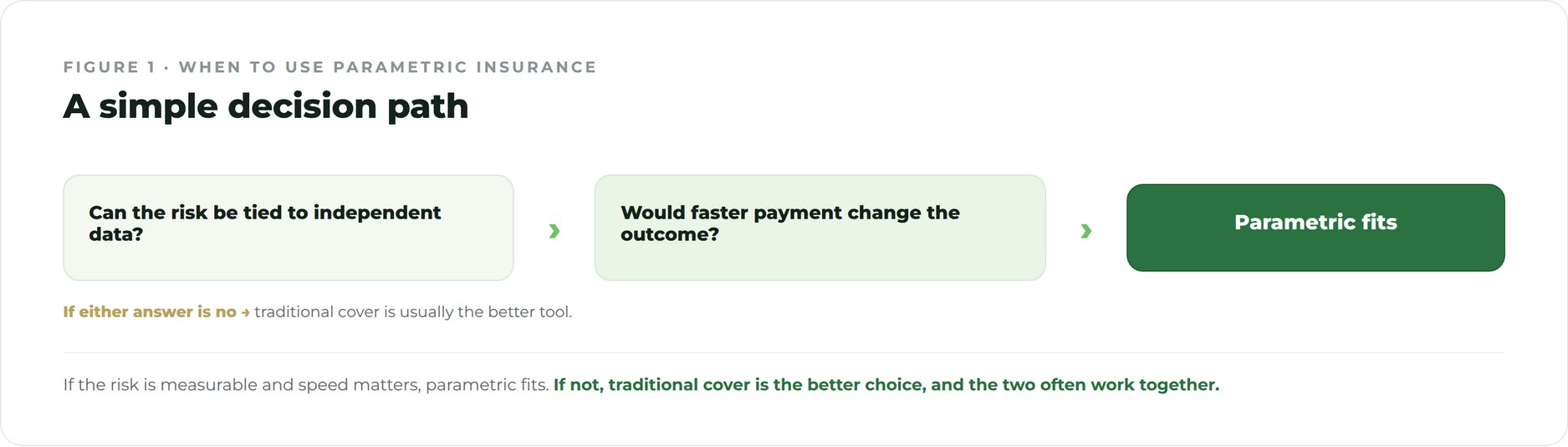
To decide whether to use parametric insurance for a given exposure, ask two questions. Can the risk be tied to reliable, independent data? And would speed of payment change the outcome? Where the answer to both is yes, parametric is worth considering. The best next step is to identify your measurable, time sensitive exposures, then test a proposed structure against your own history so you can see how it would have performed before you commit.
Questions to ask before choosing parametric
Before selecting parametric insurance for a risk, it helps to work through a few questions. Can the exposure be tied to an independent, published data source with a good history? Would a payout in days, rather than months, materially change the outcome for the business? Is the standard market offering adequate cover, or is the risk excluded, sub limited or declined? How much basis risk can the business comfortably carry? And does the payout need to match the loss exactly, or is a close, fast approximation acceptable? The answers point clearly towards or away from a parametric structure, and they also shape how the trigger should be designed.
Parametric across the business cycle
When to use parametric can also depend on timing. It is often taken up ahead of a known risk season, such as before a hurricane season for coastal operations or a monsoon for agriculture. Lenders may require it for the duration of a debt service period. Project owners may use it only during construction or commissioning, when a delay is most costly. Thinking about when the exposure bites, and structuring cover to match that window, is part of using parametric well, and it keeps the premium focused on the period that matters.