
Advantages and Disadvantages of Parametric Insurance
Parametric insurance has clear strengths and some genuine limits, and understanding both is the best way to use it well.
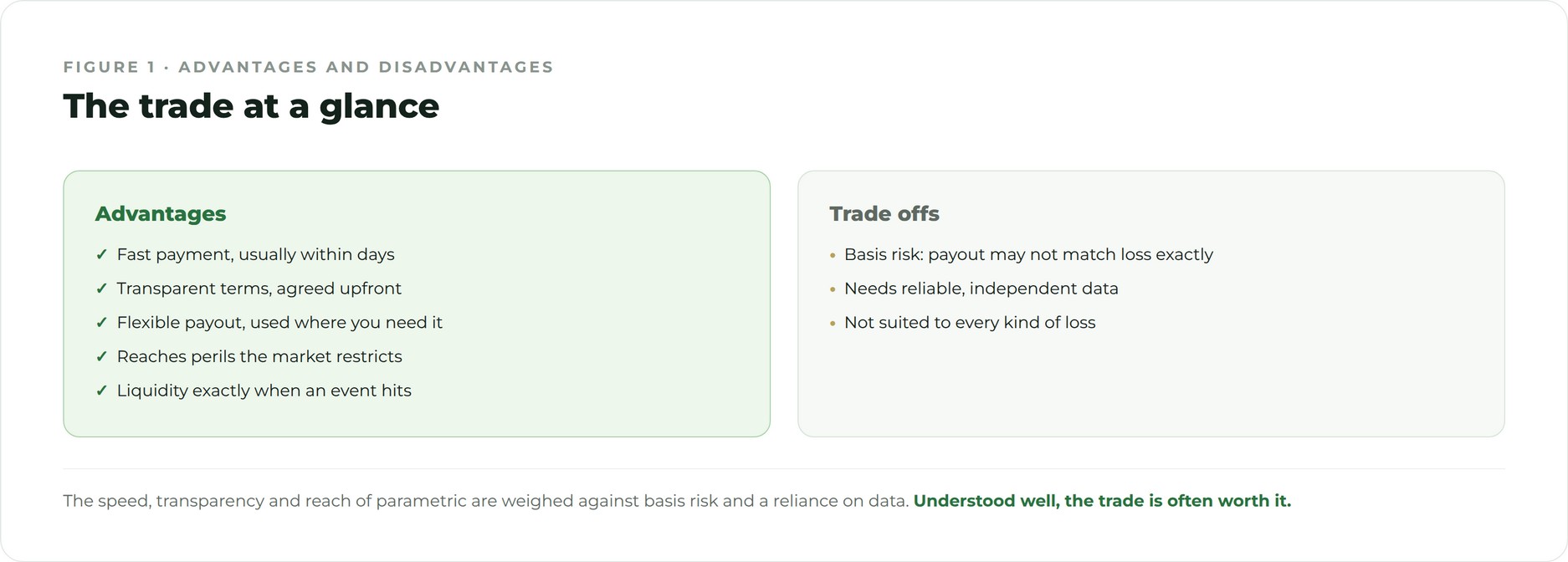
The advantages of parametric insurance are speed, transparency, flexibility and the ability to cover risks the standard market avoids. Its main disadvantage is basis risk, the gap between the trigger and your actual loss, along with a dependence on good data.
This guide sets out the advantages and disadvantages of parametric insurance honestly, so you can judge where it adds value and where traditional cover still makes more sense. A clear eyed view of the pros and cons is what separates a good buying decision from a disappointing one.
The advantages of parametric insurance
- Fast payment. Settlement in days, because the payout follows data rather than a loss assessment.
- Transparency. Terms are agreed upfront and the outcome is objective, with no loss adjusting.
- Flexibility. The payout is yours to use wherever recovery needs it, not tied to one repair.
- Reach. Cover for hard to place perils and regions the standard market restricts or declines.
- Liquidity. Usable cash exactly when an event hits, when it changes the outcome most.
- Simplicity. Claims are simple and objective, because the data decides.
The disadvantages of parametric insurance
- Basis risk. The payout may not match your loss exactly, since it pays on a measured event.
- Data dependency. It needs a reliable, independent source with a good history, which not every risk has.
- Not for every loss. Losses that cannot be tied to an index are better served by indemnity cover.
- Requires understanding. It behaves differently to traditional cover, so buyers need to understand the trigger.
How the disadvantages are managed
None of the disadvantages is a reason to avoid parametric insurance, provided they are handled properly. Basis risk is reduced through good trigger design and careful calibration, and it is measured and disclosed before cover is bought. Data dependency is managed by grading every source and choosing only those that are independent, published and durable. And the need for understanding is met by clear structuring and honest advice, so the buyer knows exactly how the cover will behave. The remaining trade off is usually small relative to the speed and certainty gained.
Who benefits most from parametric insurance
Organisations with measurable, time sensitive exposure gain the most from parametric insurance. That includes producers protecting revenue against weather, energy operators protecting output, lenders protecting loan books against correlated catastrophe risk, governments funding disaster response, and businesses with weather driven revenue. For these buyers, the advantages of speed and reach clearly outweigh the basis risk trade off, especially where conventional cover is slow or unavailable. See the sectors we serve.
Is parametric insurance worth it?
Whether parametric insurance is worth it depends on the risk. For fast moving, measurable exposures where speed of payment would change the outcome, it is often the most practical cover available, and its advantages dominate. For conventional, easily assessed losses where an exact indemnity matters more than speed, traditional cover remains the better choice. The strongest programmes use both, letting each do what it does best. Weighed honestly, the advantages and disadvantages of parametric insurance point to a clear conclusion: it is a powerful complement to traditional cover, not a wholesale replacement for it.
How parametric compares on cost
Cost is often misunderstood in parametric insurance. It is not automatically cheaper or more expensive than traditional cover. The premium reflects the probability and severity of the trigger being met, modelled from historical data, together with the limit and payout you choose. Where parametric can save money is in the absence of loss adjusting and administration, and in its ability to target exactly the exposure you care about rather than a broad, bundled policy. Where it can cost more is when a very tight trigger transfers a large share of the real risk. A fair comparison looks at the cover you actually get for the premium, not the headline number alone.
Parametric insurance and cashflow
One advantage that deserves its own mention is the effect on cashflow. Because parametric pays in days, it provides liquidity at the exact moment a business is under the most pressure, when revenue has fallen but costs continue. For lenders and investors, that predictability protects debt service and returns. For operators, it funds the immediate decisions that shape recovery. This cashflow benefit is often more valuable than the headline size of the payout, because timing, not just amount, determines how well a business absorbs a shock.