
Parametric vs Traditional Insurance
Parametric vs traditional insurance is one of the first questions businesses ask when they discover parametric cover, and the honest answer is that the two are not really rivals.
They are different tools for different jobs. Traditional indemnity insurance reimburses your assessed loss after an event. Parametric insurance pays a set amount when an agreed, measurable trigger is met.
Understanding the difference between parametric and traditional insurance is the key to knowing which to use, and when to use both. This guide compares them across payout, proof, speed, certainty and cost, and shows how a combined programme often gives the best protection.
The core difference
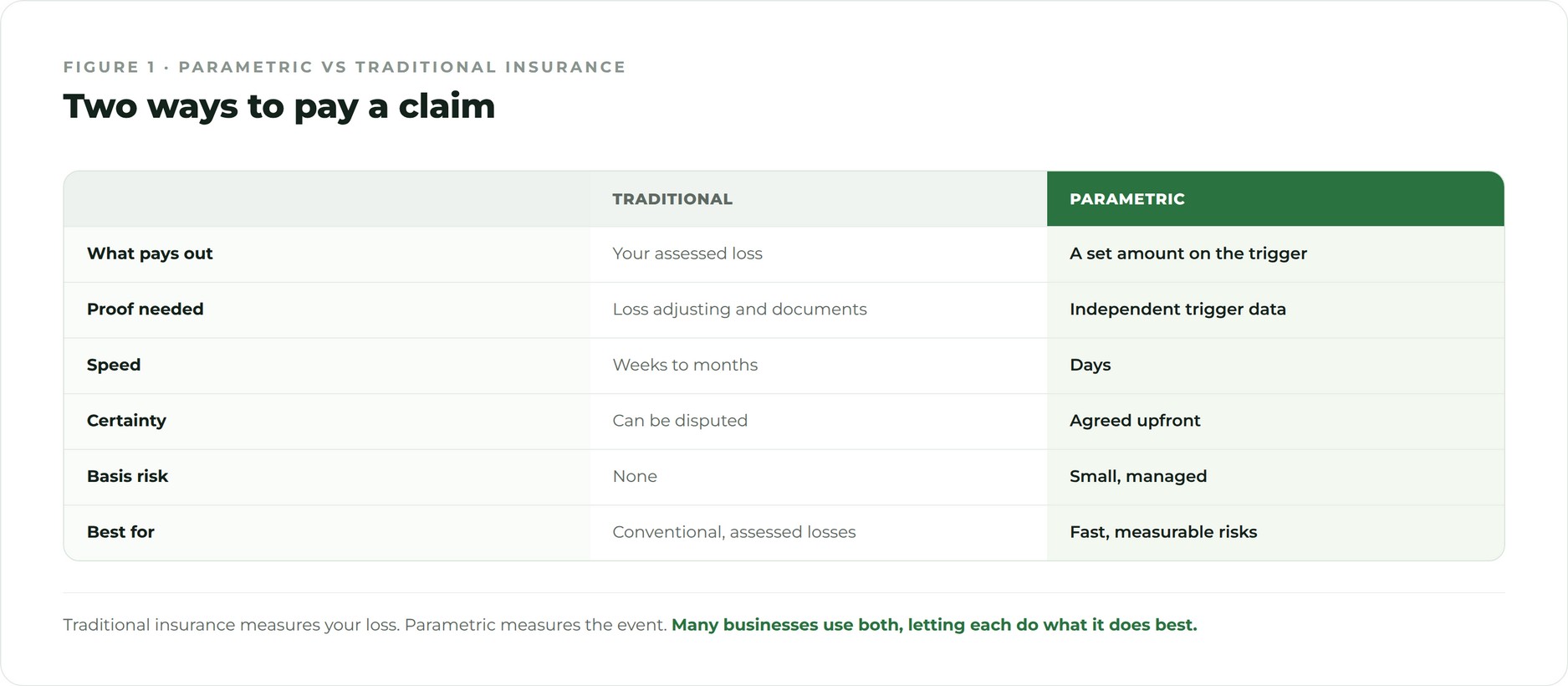
Traditional cover asks a simple question after a loss: how much were you damaged? An adjuster assesses the loss, you provide proof, and the claim is paid against your actual, verified damage. Parametric cover asks a different question: did the agreed event happen? If an independent source confirms the trigger was met, the agreed amount is paid, regardless of your specific damage. One approach measures the loss, the other measures the event. Every other difference between parametric and traditional insurance flows from that single distinction.
How traditional indemnity insurance works
Traditional indemnity insurance is what most people picture when they think of insurance. You insure an asset or an interest, and if it is damaged by a covered peril, the insurer pays to put you back in the position you were in, up to the policy limit. Its great strength is precision. Because it pays your actual loss, there is no gap between what you receive and what you suffered, which means it carries no basis risk. Its weaknesses are speed and scope. Loss adjusting takes time, especially after a widespread catastrophe, and cover comes with exclusions, deductibles and conditions. Some losses, particularly revenue lost to weather, do not fit the model at all.
How parametric insurance works
Parametric insurance pays on a trigger, not a loss. You and the insurer agree, in advance, the exact event and threshold that will trigger a payout, and the amount that will be paid. When independent data confirms the threshold has been crossed, the payout follows, usually within days. Its strengths are speed, transparency and reach: there is no loss adjusting, the terms are fixed upfront, and it can cover risks the standard market avoids. Its trade off is basis risk, the possibility that the payout does not perfectly match the loss, which good design keeps small. See how parametric insurance works.
Parametric vs traditional insurance, side by side
- Payout. Traditional pays your assessed loss; parametric pays a set amount.
- Proof. Traditional needs loss adjusting and documentation; parametric needs only the trigger data.
- Speed. Traditional runs to weeks or months; parametric to days.
- Certainty. Traditional is subject to dispute and exclusions; parametric is agreed upfront.
- Flexibility. A traditional payout repairs the specific loss; a parametric payout is yours to use freely.
- Basis risk. Traditional has none; parametric carries a managed amount in exchange for speed.
When traditional insurance is the better choice
Traditional cover is the right tool when a loss cannot be tied to an independent index, or when paying the exact loss matters more than paying quickly. Complex property damage, liability claims and many conventional risks are best served by indemnity cover, precisely because it pays what you actually lost. If your priority is a payout that matches the loss exactly, and speed is not critical, traditional insurance remains the sensible default.
When parametric insurance is the better choice
Parametric comes into its own where speed matters, where the risk is measurable, and where conventional cover is slow, restricted or unavailable. It is especially strong for weather and catastrophe exposure, for revenue that moves with conditions, and for regions where the standard market has pulled back. If a fast, certain payout would change how well your business recovers from an event, parametric is likely the better fit. See when to use parametric insurance.
Using both together
For most businesses, the real answer to parametric vs traditional insurance is not one or the other, but both. Traditional cover handles the losses it handles well, and parametric fills the gaps and adds speed. A combined programme might use indemnity cover for physical damage and a parametric layer for the weather or catastrophe exposure that hits revenue and cashflow. To decide where each fits, look at every material risk and ask two questions: can it be tied to reliable, independent data, and would speed of payment change the outcome? Where the answer to both is yes, parametric belongs alongside your traditional cover.
A common misconception
It is sometimes assumed that parametric insurance is always cheaper than traditional cover, or that it always pays out. Neither is a rule. Pricing depends on the probability and severity of the trigger, just as traditional pricing depends on the modelled loss, and a parametric policy only pays when its trigger is met. The real distinction is not price or certainty of payment, but how the payout is determined: by a measured event rather than an assessed loss. Keeping that difference in focus is the key to comparing the two fairly.
Which businesses use each type
In practice, the split follows the nature of the risk. Businesses lean on traditional cover for physical assets, liability and conventional property damage, where an exact indemnity matters. They add parametric for weather, catastrophe and commodity exposure, where speed and reach matter more and the risk is measurable. A manufacturer, an energy operator or a farm will typically hold both, using each for the part of the risk it handles best rather than choosing one approach for everything.