
How Are Parametric Claims Paid?
How are parametric claims paid?
One of the biggest advantages of parametric insurance is that there is no claims process in the traditional sense. You do not need to prove a loss, submit documentation or wait for a loss adjuster. When independent data confirms the trigger has been met, the agreed payout is settled, usually within days.
This guide explains the parametric claims process step by step, how a scaled payout is structured with attachment and exhaustion points, what governs the speed of settlement, and what you can do with the money once it arrives.
Why there is no traditional claim
A traditional insurance claim is slow because the loss has to be measured and agreed. An adjuster inspects the damage, you supply proof of loss, and the two sides settle on a figure. Parametric insurance removes that entire step. Because the payout is tied to an agreed, measurable trigger rather than your specific damage, there is nothing to inspect and nothing to negotiate. The event either met the threshold or it did not. That single change is what turns months of claims work into a settlement measured in days.
How a parametric payout is structured
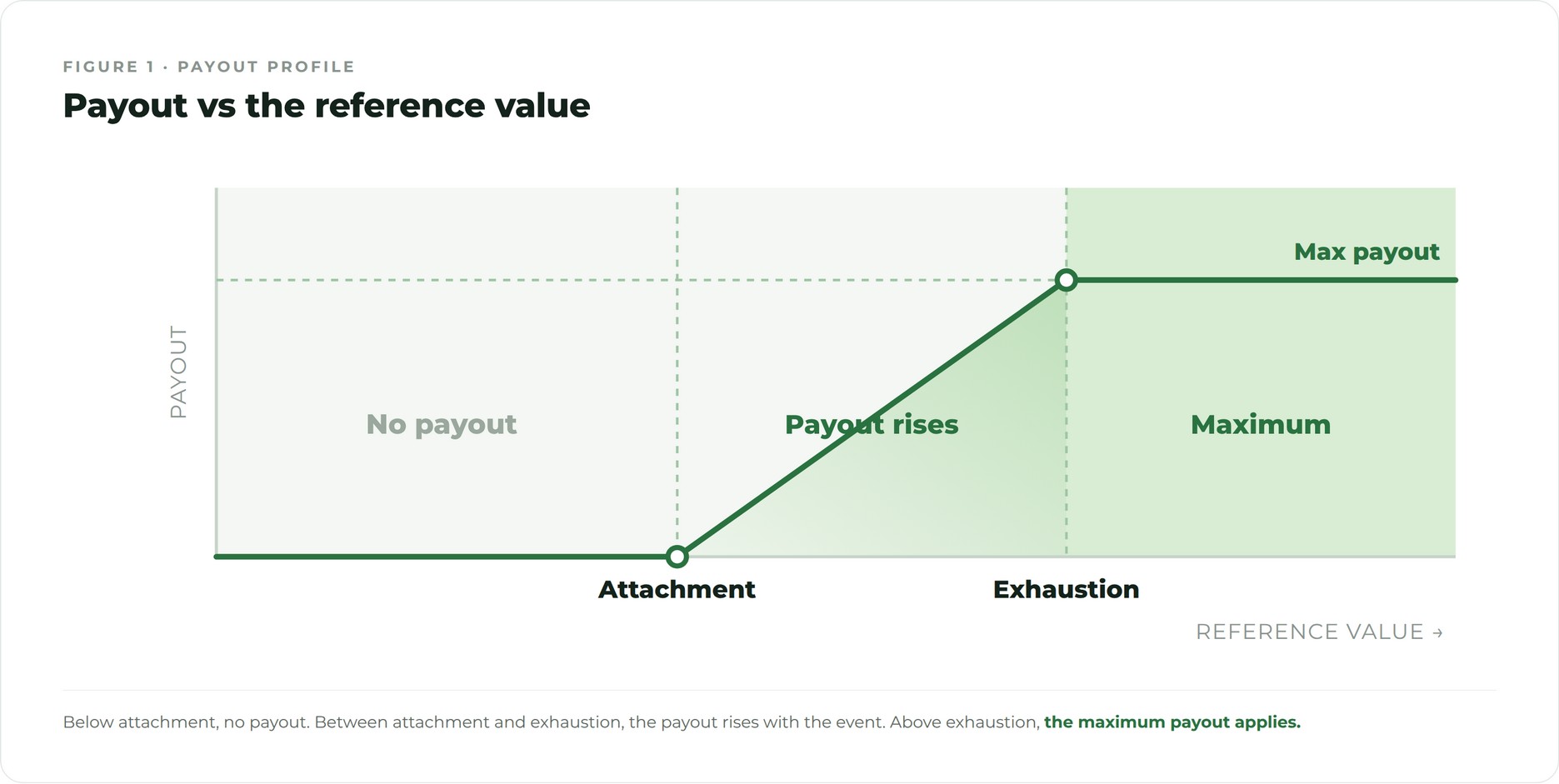
Many parametric policies pay on a scale rather than all or nothing. Below an attachment point there is no payout. Between the attachment point and an exhaustion point, the payout rises with the severity of the event. Above the exhaustion point, the maximum payout applies. Plotted against a reference value, such as a price, an index or a physical measurement, this produces the classic parametric payout profile: flat, then rising, then capped. A binary structure is simpler still, paying a single fixed amount once the trigger is met.
The parametric claims process, step by step
- The event occurs. It is measured by an independent source such as a weather index, a seismic network or a market benchmark.
- The data is checked. The reading is compared against the agreed trigger and payout scale.
- The payout is confirmed. If the trigger is met, the amount due is calculated from the contract.
- Settlement. The agreed sum is paid, typically within days.
What governs the speed of settlement
If parametric pays so fast, what determines exactly how fast? The main factor is how quickly the trigger data is published and confirmed. Some sources, such as seismic readings, are available almost in real time. Others, such as certain weather or industry loss indices, are published on a set schedule, which sets the earliest point a payout can be confirmed. A clean, unambiguous trigger settles faster than a complex one, which is why the choice of a timely, independent data source is built into the structure from the start. See what data is used in parametric insurance.
What you can use the payout for
A parametric payout is not tied to repairing a specific item. The funds are yours to deploy where recovery needs them, from operating costs and payroll to rebuilding, securing supply and reopening, which is especially valuable following a business interruption event. That flexibility is one of the quiet strengths of parametric cover. Cash in the first week after an event funds the decisions that shape recovery, which is exactly when a business has the most options and the most to lose.
A faster, simpler experience
For the policyholder, being paid on a parametric policy is closer to a switch flipping than a claim being fought. There is no adjuster to host, no schedule of loss to prepare and no negotiation to endure. The data does the work. That simplicity, combined with speed, is why so many businesses add parametric cover for the risks where a slow, contested claim would do the most damage.
What can slow a payout down
Although parametric is fast, a few things govern the timing. The biggest is the publication schedule of the trigger data: an index released monthly cannot confirm a payout before it is published, whereas a seismic reading is available almost immediately. A complex or ambiguous trigger can also add time, because the data has to be interpreted against the wording. This is why timely, unambiguous data sources are chosen at the structuring stage. When the data source and the trigger are both clean, there is very little that can delay settlement.
Payouts and the buyer experience
For the buyer, a parametric payout is a very different experience from a traditional claim. There is no schedule of loss to prepare, no adjuster to accommodate and no drawn out negotiation. The insurer monitors the same independent data the buyer can see, so both sides know a payout is coming at the same time. That transparency removes much of the anxiety that surrounds conventional claims, and it is one of the reasons buyers value parametric for their most critical exposures.