
What Data is Used in Parametric Insurance?
Data is the foundation of parametric insurance.
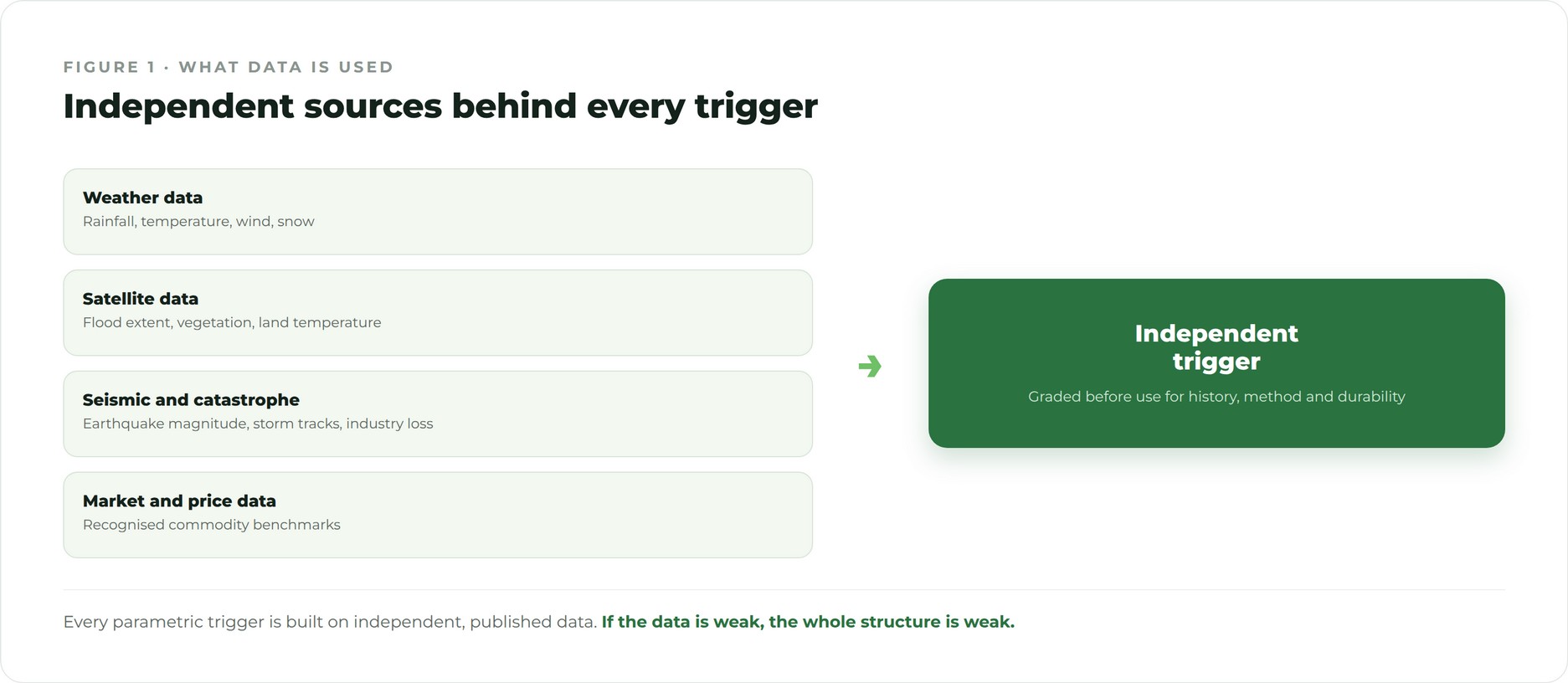
Because a parametric policy pays on a measured event rather than an assessed loss, the parametric insurance data behind the trigger has to be independent, reliable and trusted by both sides. If the data is weak, the whole structure is weak.
This guide covers the main types of data used in parametric insurance, from weather and satellite to seismic and market indices, explains what makes a source suitable for a trigger, and shows how every dataset is graded before it goes into a structure.
Why data is everything in parametric insurance
In parametric insurance, the data is effectively the contract. It decides whether the trigger is met and therefore whether the policy pays, so its quality, independence and continuity matter more than almost anything else. A conventional policy relies on an adjuster to establish the facts after a loss. A parametric policy relies on a data source to establish them automatically. That shifts the burden of trust onto the data, which is why the choice and grading of sources is such a central part of structuring parametric cover.
The main types of parametric insurance data
- Weather data. Rainfall, temperature, wind and snow, from national services and reanalysis datasets.
- Satellite data. Flood extent, vegetation, land surface temperature and active fire detection from earth observation.
- Seismic and catastrophe data. Earthquake magnitude, storm tracks and industry loss figures.
- Market and price data. Recognised commodity price benchmarks and exchange settled references for commodity cover.
Each type is explored in more depth in weather data explained, satellite data in insurance and earthquake and catastrophe data sources.
What makes data suitable for a trigger
- Independence. Published by a credible source outside the control of either party.
- A long record. A complete history to model the risk and set the threshold against.
- Durability. A low risk of being discontinued or changed during the policy term.
- A transparent method. Collected and processed in a consistent, documented way.
How a data source is graded
Before any source is used, it is graded on a set of questions. Is the reporting agency public or private? Is there a published methodology? Is the data collected automatically or by survey, and if by survey, is the sample robust? Is there any pre processing before publication? And is there a history of gaps or a risk of publication stopping over the life of the policy? Only sources that pass this review go into a structure, because a trigger built on unreliable data will fail the buyer when it matters most.
Combining data sources
Many structures blend more than one source to strengthen the trigger. Satellite data can be combined with ground based weather stations to improve coverage and accuracy. A physical parameter can be paired with an index to tighten the link to the loss. Combining sources can reduce basis risk, provided each source is itself independent and durable. The aim is always a trigger that tracks the real exposure as closely as the available data allows.
Data and trust
The independence of the data is what gives a parametric payout its authority. Because the source is neutral and published, neither the insured nor the insurer can influence the result, which is exactly what capital partners and reinsurance markets require. Good parametric insurance data is therefore not just a technical input but the basis of trust in the whole structure. See why independent data matters.
Public and private data sources
Parametric insurance draws on both public and private data. Public sources, such as national meteorological services, geological surveys and space agencies, are widely trusted and often free to access, which makes them a natural foundation for triggers. Private sources, such as commercial weather providers, index administrators and specialist monitoring networks, can offer higher resolution, faster updates or coverage where public data is thin. A good structure uses whichever source best fits the risk, provided it is independent, durable and transparent. The mix of public and private data is one reason parametric cover can now reach so many perils and regions.
Data resolution and why it matters
Resolution, both in space and time, has a direct effect on basis risk. A dataset that reports conditions on a fine grid, and updates frequently, can track a localised event far more closely than a coarse one. This is why the choice of data is not just about trust but about accuracy. Higher resolution data, often from satellites and modern reanalysis, has been one of the main forces widening what parametric insurance can cover well, because it shrinks the gap between what is measured and what a business actually experiences.