
How Parametric Models Are Built
Behind every parametric structure is a model.
Parametric models turn years of historical data into an estimate of how often an event will happen, how severe it will be, and how a proposed trigger would have paid in the past. Understanding how parametric models are built helps buyers see why a policy is priced the way it is and how much confidence to place in it.
This guide explains, in plain terms, the parametric modelling process, from data and statistical analysis to simulation and stress testing, and how that work keeps triggers robust, pricing fair and basis risk under control.
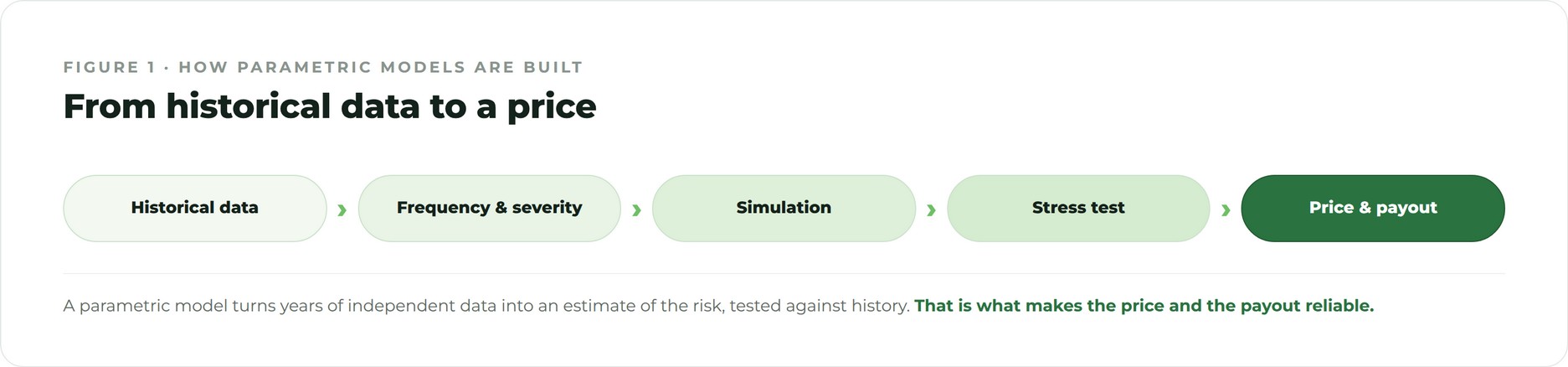
The modelling process
- Gather data. Collect long, independent historical data for the peril and location.
- Analyse the record. Study the frequency and severity of past events.
- Simulate the trigger. Test how a proposed trigger would have performed over history.
- Price the risk. Set the premium and the payout scale from the results.
Statistical analysis and simulation
The historical record is analysed statistically to understand how often events of different sizes occur. Where the record alone is not enough, simulation is used to explore many possible outcomes, including events more extreme than any directly observed. This matters most for catastrophe risk, where the rare but severe events in the tail of the distribution drive the pricing. Simulation gives a fuller picture of that tail than the limited historical record can provide on its own, which leads to more robust structures.
Testing the trigger against history
A crucial step is back testing the proposed trigger against the historical record. This shows how the trigger would have paid in past events and, where loss data is available, how closely those payouts would have matched actual losses. Back testing is the clearest way to see basis risk before a policy is written, and it lets the structure be refined until the payout tracks the exposure as closely as the data allows. A trigger that performs well across a long history is far more trustworthy than one designed on theory alone.
Stress testing and correlation
Models are also stress tested at portfolio level, and the correlation between risks is examined so exposures are understood rather than unknowingly stacked. Diversification and correlation analysis show how a set of parametric contracts would behave together under extreme conditions, which protects both the risk carrier and the capital partners behind it. This discipline is what allows parametric risk to be written responsibly at scale.
From model to structure
The model is where pricing, trigger design and basis risk come together. It sets the premium, shapes the attachment and exhaustion points of the payout, and quantifies the residual risk the buyer will carry. Good parametric models are built on independent data, tested against history and stress tested for the tail, so the finished structure behaves the way everyone expects. Understanding that a real model sits behind the cover is part of what gives parametric insurance its credibility. See how trigger calibration works.
The data behind the model
A parametric model is only as good as the data it is built on. Long, complete and independent records of the peril are essential, because the model infers the future behaviour of the risk from its past. Where the record is short, the model is less certain, and the structure has to allow for that uncertainty. This is why so much attention goes into sourcing and grading data before any modelling begins. A sophisticated model built on weak data is still a weak model, while a simple model built on strong data can be highly reliable.
Why modelling builds trust
Modelling is also what gives capital partners the confidence to support a parametric structure. Because the risk has been quantified, stress tested and back tested against history, investors and reinsurers can see the range of outcomes they are exposed to. That transparency is what allows capacity to be deployed behind parametric risk at scale. For the buyer, the same modelling means the premium reflects a genuine assessment of the risk, and that the cover has been designed to behave predictably rather than by guesswork.