
What is Basis Risk?
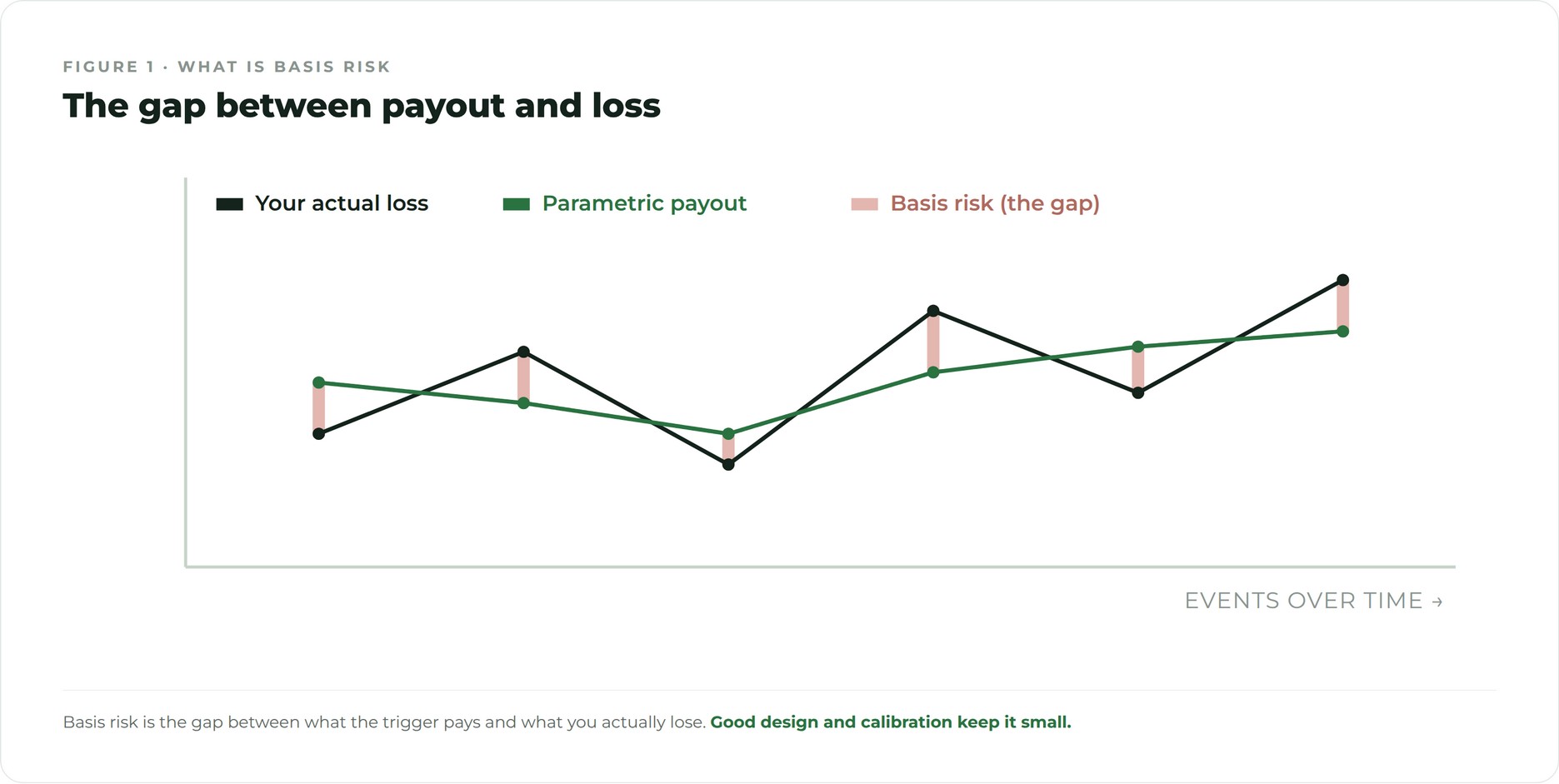
Basis risk is the gap between what a parametric trigger measures and the loss you actually experience.
In parametric insurance, basis risk is the one real trade off, and treating it openly is a mark of a good structurer. If the trigger is well designed, basis risk is small and the payout closely matches your loss.
If it is poorly designed, you could suffer a loss and receive too little, or receive a payout without a matching loss. This guide explains what basis risk is, why it happens, the different types of basis risk in parametric insurance, and how careful trigger design and calibration keep it under control.
Why basis risk exists
A parametric trigger is a proxy for your loss, not a measurement of it. That is deliberate. Measuring the event rather than your specific damage is exactly what lets parametric pay so quickly. But because the trigger stands in for your loss, a gap can open between what is measured and what you feel. The distance between the measurement point and your site, the choice of index, and the exact threshold all contribute to that gap. Some basis risk is therefore unavoidable in any parametric structure. The goal is not to eliminate it, which is impossible, but to understand it and keep it small.
The types of basis risk
- Spatial basis risk. The event is measured at a point away from your exposure, so conditions at the measurement site differ from conditions at yours.
- Temporal basis risk. The measurement window does not quite match the period in which you are affected.
- Design or product basis risk. The chosen index does not perfectly track your particular kind of loss.
In practice these overlap. A rainfall index measured at a distant station over a fixed month carries both spatial and temporal basis risk. Recognising which type dominates a given structure is the first step to reducing it.
How basis risk is reduced
- Better data. Choosing sources that closely track your exposure, including higher resolution satellite and gridded data.
- Calibration. Tuning the threshold against your own loss history so the trigger fires when you are actually hurt.
- Payout design. Structuring the payout in steps rather than a single cliff edge, so small misses do not become large gaps.
- Dual triggers. Adding a second condition where it tightens the link to your loss.
- Honest assessment. Measuring and disclosing basis risk at the design stage, before cover is bought.
Basis risk and trigger design
Basis risk cannot be separated from trigger design. The choice of index, location, threshold and payout shape all determine how closely the cover follows your loss. This is why basis risk is assessed at the structuring stage rather than treated as an afterthought. A structure that scores well on basis risk is one where, across a long run of historical events, the payout would have tracked the actual losses closely. Testing a proposed trigger against history is the most powerful way to see basis risk before you commit.
An honest trade off
Parametric insurance trades a small amount of precision for a large gain in speed and certainty. That is a reasonable bargain for many risks, but only if the trade off is understood. A responsible parametric risk partner assesses basis risk openly and tells you where a parametric structure is, and is not, the right tool. Where basis risk would be too large to accept, the honest answer is that a different structure, or traditional cover, is the better fit. Transparency about basis risk is what makes the rest of the promise credible.
A worked example of basis risk
Imagine a farm in the agriculture sector insured against drought using a rainfall index measured at a station 20 kilometres away. In most years the station and the farm see similar rainfall, and the payout matches the loss well. But in a year when a local dry spell hits the farm while the station records normal rainfall, the farm suffers a loss with no payout. That is spatial basis risk in action. The same farm might also face temporal basis risk if the index window does not quite match its most sensitive growing period. Seeing these cases concretely is the best way to understand why measurement choices matter so much.
How much basis risk is acceptable?
There is no single answer, because it depends on the buyer. A business using parametric as a fast top up alongside traditional cover can accept more basis risk than one relying on it as primary protection. The right approach is to measure the residual risk, show it clearly through back testing against history, and let the buyer decide whether the trade off suits their needs. Acceptable basis risk is the amount you understand and are comfortable carrying, not zero.