
Index Based Insurance Explained
Index based insurance is a form of parametric cover where the payout is tied to the value of an agreed index, such as a rainfall total, a temperature average or a market wide loss figure.
If the index crosses the threshold, the policy pays. Index based insurance is widely used in agriculture and in developing markets, where it can protect many people quickly and affordably.
This guide explains how index based insurance works, the common indices used, where it is applied, and how it fits within parametric insurance more broadly.
What index based insurance is
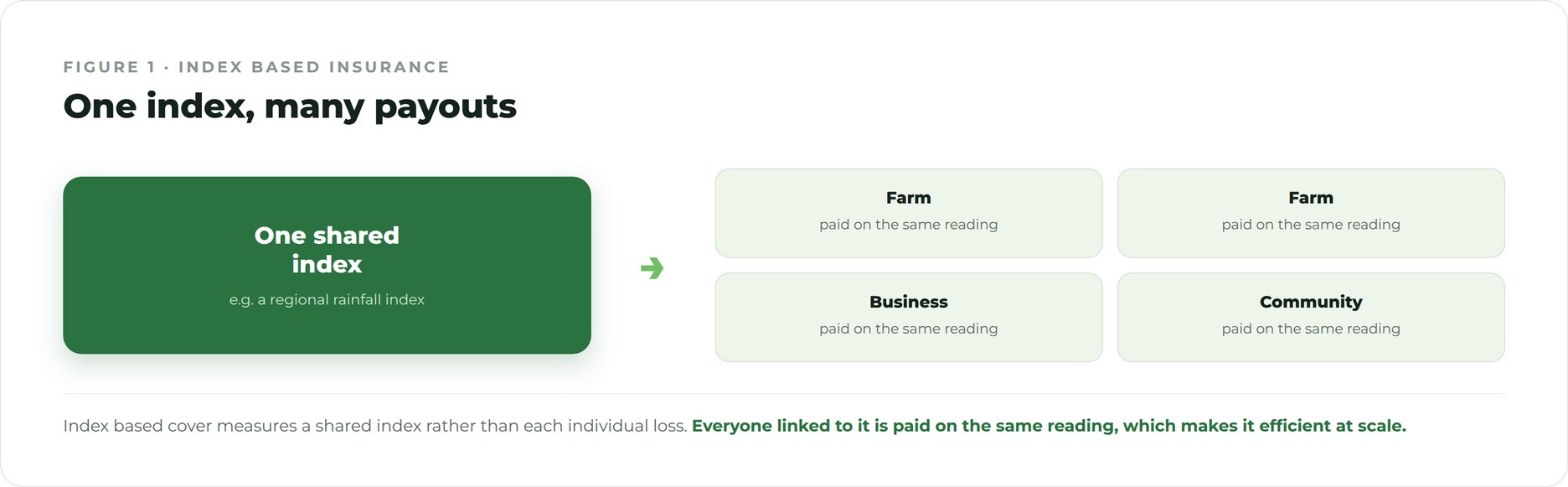
Rather than measuring one policyholder's loss, index based insurance measures a shared index that stands in for the loss across an area or a market. Everyone linked to the index is paid on the same reading, which makes it efficient to run at scale. Because there is no need to visit and assess each individual loss, index based cover can reach large numbers of policyholders quickly and at low cost. It is, in effect, parametric insurance applied to a group rather than a single asset.
How an index trigger works
An index is chosen, a threshold is set, and a payout scale is agreed. When the published index crosses the threshold, payouts are made automatically to everyone covered. The index might fall, as with a rainfall index for drought, or rise, as with an industry loss index for catastrophe. Either way, the mechanism is the same as any parametric trigger: an agreed, measured value produces an agreed payout, with no loss to prove.
Common indices used
- Rainfall and drought indices. For agriculture, protecting revenue against a dry season.
- Temperature indices. For energy and health, responding to heat or cold.
- Industry loss indices. For catastrophe and industry loss warranties.
- Vegetation indices. Derived from satellite data, tracking crop and pasture condition.
Where index based insurance is used
Index based insurance is widely used to protect farmers and communities at scale, including development and smallholder programmes supported by governments and international bodies. Because it pays quickly and costs little to administer, it can extend cover to people the traditional market cannot reach economically. It is also used by corporates and lenders as an efficient way to cover weather and catastrophe exposure across a portfolio. In each case its strength is reach and speed. See agriculture.
Index based insurance and basis risk
The main trade off in index based insurance, as in all parametric cover, is basis risk. Because everyone is paid on a shared index rather than their individual loss, some policyholders may receive more or less than they actually lost. Careful index selection, good spatial resolution and sensible thresholds keep this gap small. Understanding basis risk is essential to using index based insurance well, and a responsible provider will be clear about where it sits before cover is bought.
Index based insurance and development
Index based insurance has become an important tool in international development. Because it can protect large numbers of smallholder farmers quickly and cheaply, it is used in schemes backed by governments, development banks and aid organisations to build resilience against drought and flood. When a bad season hits, payouts reach whole communities within days, helping families avoid selling assets or falling into debt. This ability to deliver protection at scale, in places the traditional market cannot serve, is one of the clearest social benefits of parametric insurance.
Designing a fair index
The fairness of index based insurance depends on how well the index represents the losses of those it covers. A poorly chosen index leaves too many policyholders with payouts that do not match their experience. Designing a fair index means selecting a measure that genuinely drives local losses, using data at a fine enough resolution to capture local variation, and setting thresholds that reflect real conditions on the ground. Where possible, the index is tested against historical outcomes for the area, so its performance can be seen before it is relied upon.