
Frequently Asked Questions About Parametric Insurance
Parametric insurance is still new to many buyers, so the same questions come up again and again.
This parametric insurance FAQ answers the most common ones in plain language, from how quickly a policy pays to how it is priced and whether it replaces traditional cover.
Each answer is short and practical, and links through to the fuller guides where you want more detail. For a complete introduction, start with what is parametric insurance and how it works.
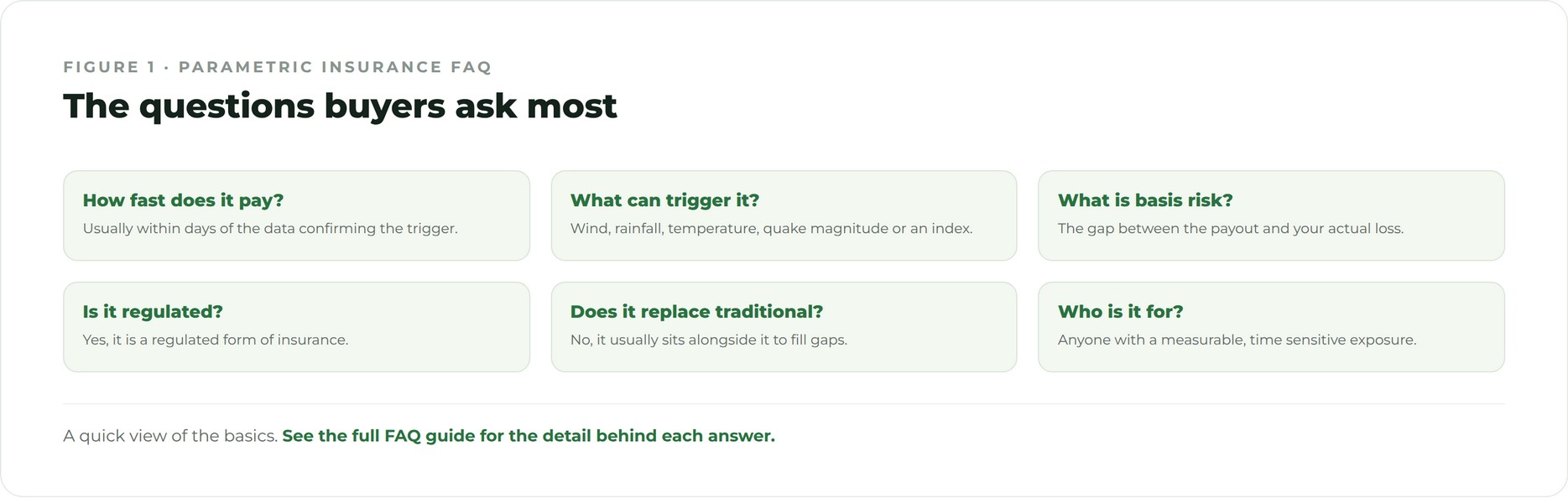
Your questions answered
How quickly does parametric insurance pay?
Once independent data confirms the trigger, settlement is usually a matter of days, because there is no loss adjusting to complete. Most of the elapsed time is simply the wait for the official data to be published, not a wait for a decision.
What can trigger a payout?
Any measurable parameter from a credible independent source, such as wind speed, rainfall, temperature, an earthquake magnitude or an industry loss index. The trigger and the level it must reach are agreed and written into the contract before cover starts.
What is basis risk?
Basis risk is the gap between what the trigger measures and your actual loss. Because parametric pays on a measured event rather than your specific damage, a small gap can open between the two. Good trigger design and calibration keep it small, and it is disclosed before you buy.
Does parametric insurance replace traditional insurance?
Not usually. It is most often used alongside conventional cover to fill gaps and add speed, especially for weather and catastrophe risk. Many businesses hold both, letting each do what it does best.
How is parametric insurance priced?
It is priced on the probability and severity of the trigger event, modelled from long historical data, together with the limit and payout structure you choose. A higher chance of the trigger being met, or a larger payout, means a higher premium.
Is parametric insurance regulated?
Yes. Parametric insurance is a regulated form of cover. Trigger operates through a Class 3 insurer authorised in Guernsey and works alongside A rated reinsurance markets.
Who is parametric insurance for?
Corporates with exposed revenue, lenders, governments, producers and reinsurance markets seeking diversifying, data driven risk. In short, anyone with a measurable, time sensitive exposure where speed of payment matters.
Can the payout be more or less than my loss?
Yes. Because it pays on the trigger rather than your assessed loss, the payout can differ from your actual loss. Careful design keeps the payout closely aligned with what you experience, but a small difference is the trade off for speed and certainty.
What data is used to confirm the trigger?
Independent, published sources such as national meteorological services, seismic networks, earth observation satellites and recognised industry loss and market indices. Every source is graded before use to make sure it is reliable and durable.
What is the difference between parametric and index based insurance?
Index based insurance is a form of parametric cover where the payout is tied to a shared index across an area or market, rather than to a single insured asset. All index based insurance is parametric, but not all parametric cover is index based.
How long does a parametric policy last?
Like other insurance, the term is agreed in the contract. Many parametric policies run for twelve months, but they can be structured around a specific season, a construction period or a debt service window.
Can I combine several perils in one parametric policy?
Yes. Multi peril structures combine two or more perils, and portfolio structures cover multiple locations and perils as a single programme, which can bring diversification benefits.
What happens if the trigger is nearly but not quite met?
With a binary trigger, no payout is made if the threshold is not reached. Scaled and stepped structures reduce the impact of just missing a threshold by paying more gradually as the event grows, which softens this cliff edge.
Do I need my own historical loss data to buy parametric cover?
It helps, because it lets the trigger be calibrated to your experience, but it is not always essential. Where your own loss history is limited, the trigger can be built and tested against independent records of the peril.